

Building a system that can recognise risk, guide families, and protect children before Type 1 Diabetes becomes clinical
- By:
- Lama Saleh | Partner Content
In medicine, the ultimate breakthrough is not merely treating a condition, it is securing time. For generations, the global approach to Type 1 Diabetes (T1D) has been strictly reactive, defined by how well we manage the disease after it arrives.
Today, here in the UAE, we are fundamentally rewriting that trajectory. Driven by a national health vision that consistently translates ambition into clinical reality, we are moving away from reactive symptom management. Instead, we are establishing a new standard of care focused explicitly on the prevention and delaying the progression of Type 1 Diabetes (T1D).
Targeting the Silent Phase
This relentless drive for medical advancement aligns perfectly with Sanofi’s purpose of chasing the miracles of science to improve people’s lives. Over our five-decade partnership in this region’s healthcare journey, this shared focus has delivered tangible clinical milestones. In May 2024, the UAE emerged as a regional pioneer by introducing the first disease-modifying intervention capable of delaying clinical Stage 3 T1D.
To understand the magnitude of this shift, we must look at how the disease operates. Science dictates that a T1D diagnosis does not happen overnight. The autoimmune process begins silently, long before excessive thirst, fatigue, or any physical symptoms emerge.
This silent phase, known as Stage 2, presents a critical window for intervention. By shifting our focus to the immune system itself during this window, we are no longer just treating the symptoms of T1D; we are targeting the underlying autoimmune process to preserve remaining beta cell function [1].
Expanding the Window of Protection
Crucially, this scientific capability is expanding to protect those who need it most. Recent global milestones in pediatric endocrinology mean that these proactive interventions are no longer limited to adults. We are now seeing the extension of these life-changing therapies to younger populations, reaching children from their earliest years, as young as one year of age.
Disease-modifying innovations to our youngest patients is a definitive statement from the medical community. It declares that our youth deserve the absolute best that modern science has to offer, and that we have a shared responsibility to protect their futures before the clinical burden begins.
For parents, time can mean fewer nights spent worrying about sudden changes in blood sugar. It can mean more opportunity to understand the disease, build confidence, and work closely with physicians before daily management becomes unavoidable. For the healthcare system, time can mean better readiness. More structured follow up. More informed monitoring. More opportunity to reduce the risk of avoidable emergencies.
The Human Impact: Preserving Childhood
To fully grasp the impact of this advancement, we must look beyond clinical data and focus on human reality. For a family, delaying the onset of Stage 3 T1D translates to invaluable, insulin-free time. It means postponing the relentless daily demands of glucose monitoring, the fear of severe hypoglycemia, and the heavy emotional toll known as “diabetes distress.” Most importantly, it grants a child the profound gift of a more uninterrupted childhood.
Building a Proactive Ecosystem
Yet, scientific breakthroughs are only effective when integrated into a prepared healthcare ecosystem. Because the early stages of T1D are silent, proactive autoantibody screening, particularly for those with a family history of the condition is the only definitive method to identify who is at the threshold.
At Sanofi, our commitment to the Gulf region extends far beyond delivering therapies. We are actively partnering with the healthcare authorities, specialists, and patient communities to elevate diagnostic readiness and build the infrastructure required to make early detection a standard of care.
The UAE has every foundation needed to pioneer this new era of proactive autoimmune care. Its vision for a future-ready, patient-centered healthcare system is already in motion. Its appetite for public-private partnership and its proven track record of converting ambition into action are exactly what this moment demands.
The story of diabetes care in the UAE is one of continuous, inspiring progress. By proactively protecting the health of our children today, we are not merely advancing medical science, we are preserving the very foundation of this nation’s tomorrow. After more than five decades as a partner in this region’s healthcare journey, I am immensely proud to see Sanofi at the forefront of this specific paradigm shift. Together, we are no longer just reacting to Type 1 Diabetes. We are anticipating it, we are delaying it, and we are building a system that can recognise risk, guide families, and protect children before Type 1 Diabetes becomes clinical.
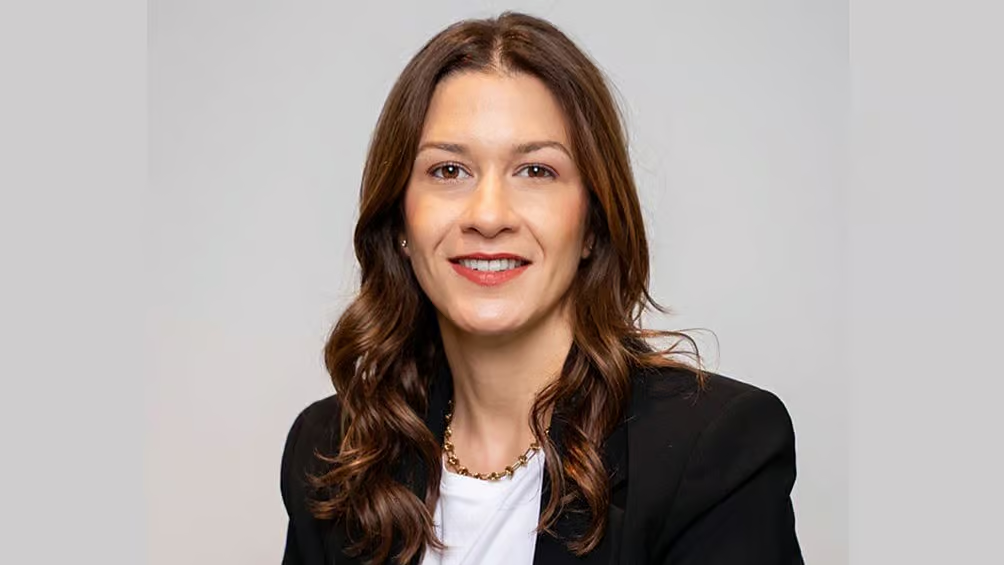
Lama Saleh is general manager Greater Gulf, General Medicines at Sanofi.
References:
1. Herold KC, Bundy BN, Long SA, et al. An Anti-CD3 Antibody, Teplizumab, in Relatives at Risk for Type 1 Diabetes. New England Journal of Medicine. 2019;381(7):603–613. DOI: 10.1056/NEJMoa1902226
Source: Khaleej Times