

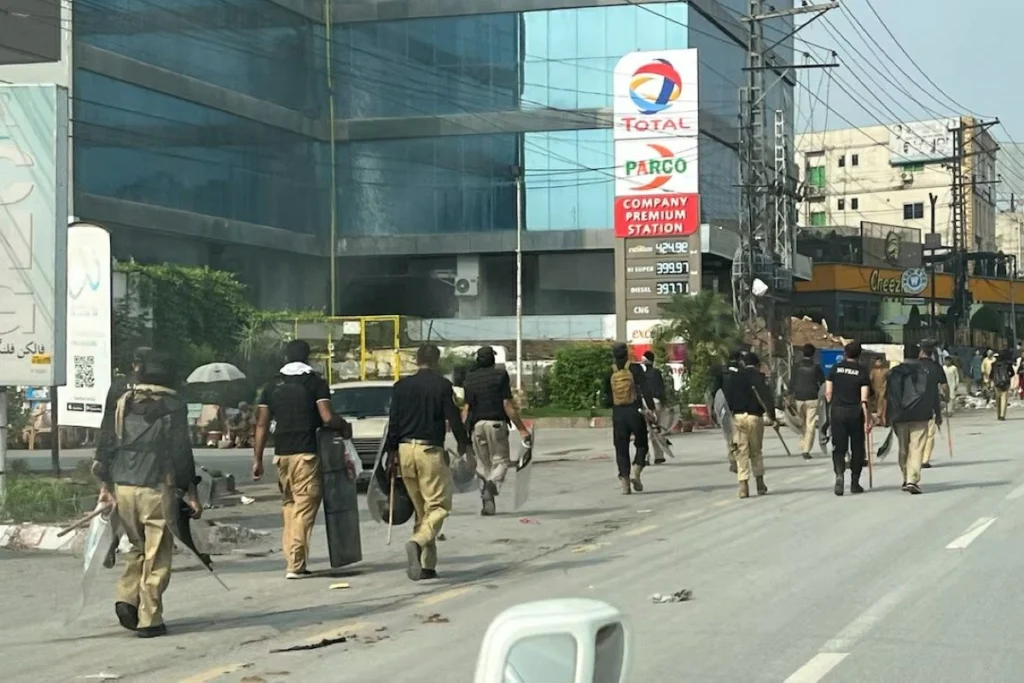
ISLAMABAD —Pakistan’s President President Asif Ali Zardari declared a state of emergency and suspended a provincial government led by the party of jailed former Prime Minister Imran Khan on Sunday, which the federal government said had failed to tackle militancy in the province bordering Afghanistan.
The state of emergency and imposition of a new governor in Khyber Pakhtunkhwa sharply escalates a standoff between Khan’s Pakistan Tehreek-e-Insaf (PTI) party and the government, and comes a week after PTI supporters gathered in the province intending to march on Islamabad to demand Khan’s release.
Hundreds of activists and three of Khan’s sisters have been detained ahead of the planned march, in what the PTI called one of the strongest crackdowns in years.
Information Minister Attaullah Tarar announced an 11-member advisory council, which will run provincial affairs under the governor.
He accused the Khyber Pakhtunkhwa government led by Chief Minister Sohail Afridi of forming an “unholy alliance” with militants. “Failing to perform constitutional responsibilities is one thing and empowering those who martyred innocent citizens and security forces and attacked mosques is quite another,” Tarar said.
Zardari’s announcement came hours after Prime Minister Shehbaz Sharif’s office said that the federal Cabinet had recommended emergency rule, accusing the provincial government of “deliberate disengagement from the fight against terrorism.”
Pakistan’s constitution allows the government to take over from provincial authorities during an emergency, and Law Minister Azam Nazeer Tarar said a provincial governor would take charge in Khyber Pakhtunkhwa, which has suffered an increasing number of militant attacks in recent months.
Tarar told a news conference in Islamabad that the governor will initially be in place for six months, but could stay for as long as needed. The interior ministry said it would be deploying troops in the province.
Restrictions have been placed on the movements of Afridi, one of his close aides told Reuters.
The measures place the province under the authority of an appointed governor, who represents the federal government.
Khan, Sharif’s main political rival, has been imprisoned since 2023 on corruption and other charges that he and his party say are politically motivated. Despite his imprisonment, he retains a substantial and passionate support base, keeping him at the center of Pakistan’s turbulent political landscape.
Interior Minister Mohsin Naqvi accused the provincial government of neglecting counterterrorism efforts while focusing on securing Khan’s release.
Naqvi said delays in decision-making and poor coordination between Islamabad and the provincial government had allowed militants to gain ground, prompting the decision to impose an emergency in the province. Law Minister Azam Nazeer Tarar said militant violence in the province had increased by 196 percent in recent years.
The party’s last large-scale protest two years ago ended in deadly clashes with security forces and Khan’s 2023 arrest sparked nationwide riots that threatened the military’s standing.
Khan’s spokesperson Zulfiquar Bukhari condemned the suspension of the provincial government, calling it a “disguised coup.” He said the Khyber Pakhtunkhwa government was the only one with a genuine popular mandate following the February 2024 parliamentary elections, which Khan’s party says were rigged.
“Now that little bit of democracy is also gone,” Bukhari said in a statement.
Referring to recent talks between Khan’s party and the federal government, Bukhari accused officials of having no intention of reaching an agreement. He said government representatives had focused on counterterrorism, while Khan’s representatives had come to discuss the imprisoned leader’s basic rights.
Talks between Khan’s party and the federal government last week on postponing the march failed.
Besides Khan’s release, his party demanded his transfer to a hospital and permission for his family to visit him. Sharif’s government has said Khan is in good health and receives regular family visits but maintains that meetings with the imprisoned former leader cannot be used for political purposes.
Source: Saudi Gazette