

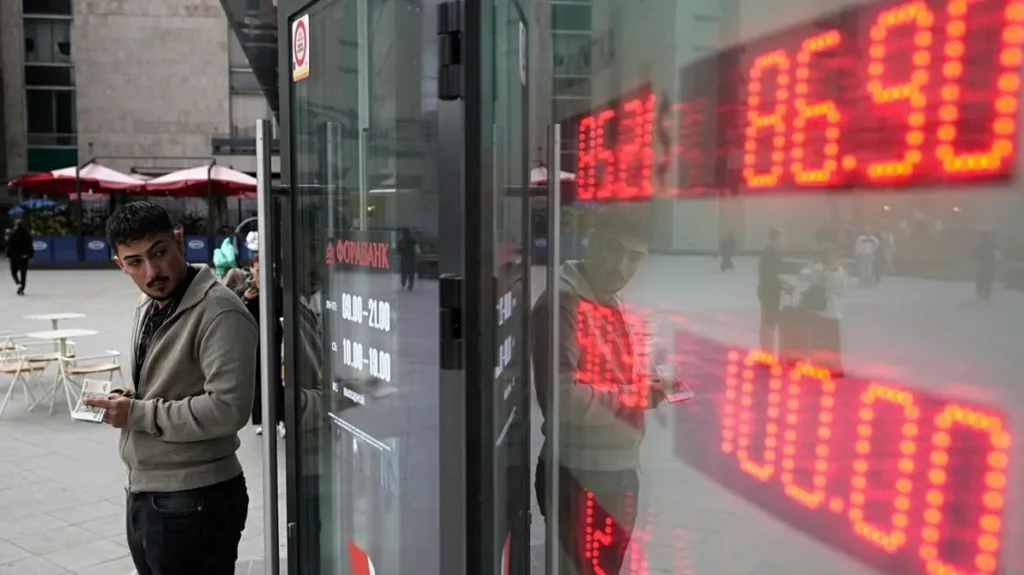
MOSCOW — Russians are withdrawing billions of dollars from the country’s banks as growing fears that the Kremlin could possibly move to freeze or nationalize private deposits to fund its war in Ukraine.
Nearly $3.4 billion was withdrawn in the first two weeks of August, according to Russian Central Bank data. That followed $7.3 billion in July and more than $4.5 billion in June.
The amount withdrawn so far this year has already exceeded the $24.7 billion removed during the first year of Russia’s full-scale invasion of Ukraine.
Data from the Banks.ru financial marketplace show that demand for cash began rising in early March and has continued growing, with around 300 billion roubles ($3.54 billion) leaving accounts every month.
Five of Russia’s seven largest banks have recorded net outflows of individuals’ deposits.
Gazprombank has been the most affected, losing 299.5 billion roubles ($3.53bn) — 10.8% of its total deposits — over four months. Rosselkhozbank shed 270.5 billion roubles ($3.19bn), a fall of more than 15%.
Alfa-Bank, Russia’s largest private lender, lost 179.4 billion roubles ($2.11bn) or 5.6% of deposits. Sovcombank and VTB recorded further outflows of 81.7 billion roubles ($963m) and 20.4 billion roubles ($240m) respectively.
Sberbank initially held steady, but its depositors have also turned to cash: 211.6 billion roubles (€$.50bn) left in June, followed by a further 31.8 billion roubles ($374m) in July. T-Bank was the exception, recording an increase of 193 billion roubles in deposit volume.
The total amount of cash in circulation rose by 643.4 billion roubles ($7.57bn) in July alone, the largest monthly increase since the start of the year, according to the Bank of Russia. In the first half of August, a further 300 billion roubles were withdrawn.
The withdrawal is being driven by two overlapping fears that Ukrainian drone strikes could destabilize the financial system, and that the Russian government might move to seize or freeze deposits to cover mounting war costs.
The second scare is grounded in recent events. Russian prosecutors transferred approximately $51.5 billion (€44.3bn) in private assets to state control last year, according to the Washington Post.
In June, authorities seized around $7.6 billion (€6.5bn) in assets linked to billionaire Vadim Moshkovich, founder of the agricultural holding company Rusagro.
Putin has simultaneously been extracting what officials describe as voluntary “donations” from oligarchs, with hundreds of billions of roubles flowing into the federal budget by mid-August, the Russian business daily Vedomosti reported.
Russian banks have spent years extending government-directed loans to defence industries at the Kremlin’s instruction.
Large companies are also moving money beyond the reach of domestic regulators, with more than $9.4 billion flowing out of Russia’s banking system in the second quarter of 2026 alone, according to central bank data.
In 2022, Russians also pulled money from banks in significant quantities following the invasion and the initial wave of Western sanctions.
The central bank temporarily raised interest rates to 20% and imposed capital controls to stabilise the system. Those controls were later lifted and the rush subsided, but the current trend is larger and longer in scale.
Russia’s broader economic position is deteriorating. GDP expanded just 0.3% in the first half of 2026, compared with 1.2% in the same period last year, according to the Kremlin’s own data, which cannot be independently verified.
Andrei Klepach, chief economist at the state development corporation VEB, was dismissed over the weekend after publicly questioning whether Russia could win a prolonged war.
“We will not win the competition in this war of attrition. We’re under the illusion that everything will collapse. It hasn’t, and it won’t. Our costs are mounting,” he said at a Moscow Exchange economic forum in May.
Source: Saudi Gazette