

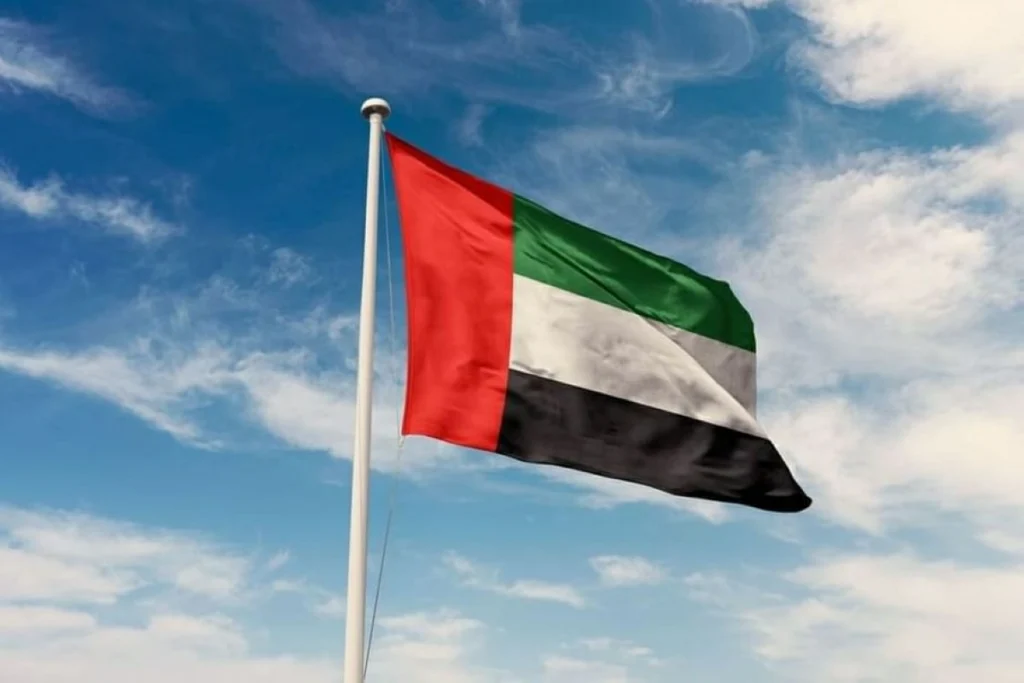
ABU DHABI — The United Arab Emirates has accused Iran of a “brazen” attack on two tankers in the Strait of Hormuz on Monday, killing an Indian crew member and wounding eight others.
The strait remains a key flashpoint between the US and Iran, with both sides clashing over the waterway’s control on Monday after exchanging strikes in the region over Sunday night.
As tensions over the international waterway ramped up, the UAE said on Monday night that Iranian cruise missiles targeted national oil tankers Mombasa and Al Bahiyah with two Iranian cruise missiles while transiting the southern shipping lane of the Strait of Hormuz, within Omani territorial waters.
In a statement, the UAE Ministry of Foreign Affairs confirmed that the Iranian hostile attack resulted in the death of one Indian national and the injury of eight others, including four who sustained serious injuries.
The injured comprise six Indian nationals and two Ukrainian nationals. The ministry extended its sincere condolences and sympathy to the family of the victim, as well as to the government and people of India, and wished all the injured a speedy recovery.
The ministry underscored that this Iranian hostile attack constitutes a flagrant violation of UN Security Council Resolution 2817, which affirmed the importance of freedom of navigation, and rejected the targeting of commercial vessels or the obstruction of international maritime routes.
The ministry emphasized that targeting commercial shipping and using the Strait of Hormuz as a tool of economic coercion or blackmail constitutes an act of piracy and poses a direct threat to the stability of the region, its peoples, and global energy security.
The UAE stressed the need for Iran to halt these unprovoked attacks, ensure its full commitment to an immediate cessation of all hostilities, and the complete and unconditional reopening of the Strait of Hormuz in order to safeguard regional security, and maintain the stability of the global economy and trade.
Iran’s Islamic Revolutionary Guard Corps (IRGC) confirmed the strikes via a statement to Telegram, where it said two tankers had ignored warnings, turned off navigation systems and attempted to pass through a mined route.
In response, the IRGC said it had hit the tankers and disabled them.
It added that “co-operation with the aggressor enemy” would only lead to regret, damage and delays in opening the Strait, as well as the “creation of an energy crisis in the world”.
Oil prices edged higher in Asian trade on Tuesday. Brent crude was up by 0.7% at $83.87 (£62.79) a barrel, while US-traded oil was 0.9% higher at $79.04.
That followed a more than 9% jump in the price of Brent on Monday as the conflict escalated.
In a Truth Social post earlier in the day, Trump said the US was reinstating a naval blockade of Iranian ports and would impose a 20% charge on all cargo shipped through the Strait of Hormuz.
Trump said this would stop “Iran’s ships or customers” from entering or leaving the key oil shipping route, but “all other countries will have fair and open use of the Strait”. The blockade will be in effect from 16:00 Eastern Time (20:00 GMT) on Tuesday.
“The U.S.A. will be, from this point forward, known as “THE GUARDIAN OF THE HORMUZ STRAIT,” but as such, and as a matter of FAIRNESS, will be reimbursed, at the rate of 20% on all cargo shipped, for any and all costs necessary to do the job of providing safety and security to this very volatile section of the World,” he wrote.
Iran’s foreign minister responded to the announcement of a blockade by saying that Tehran would remain the Strait’s “GUARDIAN”, using Trump’s word.
Trump earlier told Fox News the US would “probably run” the Strait of Hormuz, claiming that Iran “broke” a deal that was made with the US.
“We are taking over the strait,” he said.
Responding to Trump’s Strait of Hormuz announcement, Iranian Foreign Minister Abbas Araghchi wrote in a post on X: “POTUS is absolutely right. Whoever provides secure and safe passage of commercial vessels through the Strait of Hormuz should be compensated for this service.”
He continued: “Iran has always been the GUARDIAN of the Strait and will remain so FOREVER.”
“20% is of course too much. We will be fair,” Araghchi added.
Meanwhile, a spokesperson for the International Maritime Organization, the UN agency regulating global shipping, was quoted by Reuters news agency as saying that “IMO stands firmly against charging fees for passage through straits used for international navigation”.
“There is no legal basis through which to introduce mandatory tolls simply to transit through a strait,” the spokesperson added.
Before Trump’s announcement, Iran’s top military headquarters said it would not allow the US to “interfere in the management” of the Strait of Hormuz.
In a statement shared by Iranian media, Ebrahim Zolfaghari, spokesperson of Khatam al-Anbiya, said “repeated adventurism and malicious actions” from the US in the strait have “seriously endangered regional security, international trade and the passage of oil tankers and commercial vessels”.
Any co-operation with the US would be considered an act of “war” against Iran’s sovereignty, he added, warning that if the conflict spreads “the flames of war will engulf all the countries of the region”.
United Nations rules allow countries to exercise control of territorial seas up to 12 nautical miles (13.8 miles) from their coastline. At the narrowest point, the Strait of Hormuz and its shipping lanes lie entirely within Iran and Oman’s territorial waters.
Iran effectively shut down the strait through which some 25% of the world’s oil and 20% of global liquefied natural gas previously passed after the US and Israel launched strikes against Iran on 28 February.
Tehran retaliated by firing missiles and drones on Israel and US military bases in a number of Gulf countries.
Iran’s Islamic Revolutionary Guards Corps earlier fired on commercial ships attempting to go through the strait without its permission, and seized two vessels. Maritime traffic through the strait dropped dramatically, triggering a rise in oil prices.
The US first imposed a naval blockade of all Iranian ports in April to put pressure on Tehran. Roughly five weeks later, the US military said it had redirected 100 commercial vessels and disabled four under the blockade.
The US lifted the blockade in June as part of a memorandum of understanding between the two countries that aimed to end the conflict, but disputes over the strait resurfaced.
Now, many US allies are likely to baulk at the prospect of reimbursing the US and paying 20% of all cargo shipped, and Trump detractors at home and abroad are likely to point out that the strait was open and unencumbered before the war began.
Source: Saudi Gazette