

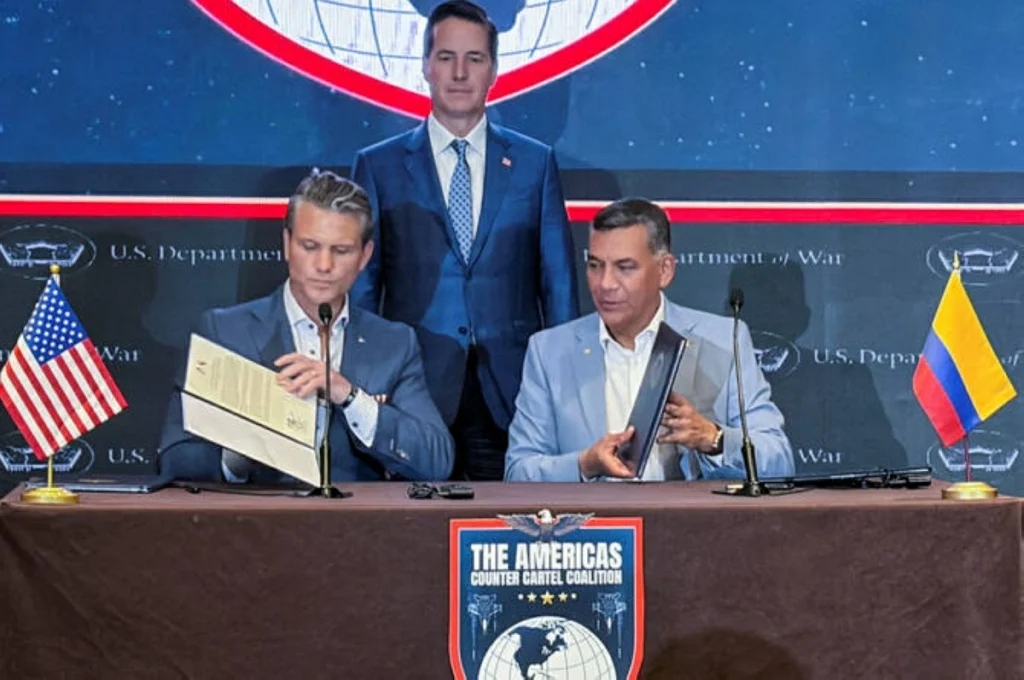
PANAMA CITY — Colombia has authorized joint military operations with the United States to target drug traffickers, US Defense Secretary Pete Hegseth said on Wednesday, as he welcomed the country into a military-led counternarcotics coalition, expanding Washington’s campaign against cartels in Latin America.
Colombia had authorized “joint military operations to destroy terrorists and terror networks,” Hegseth told a gathering of the US-led Americas Counter-Cartel Coalition in Panama.
“Yes,” he replied when asked if he had discussed with his Colombian counterpart joint strikes against armed groups such as the National Liberation Army (ELN), which the US designates as a terrorist group, and remnants of the Revolutionary Armed Forces of Colombia.
“Designated terrorist organizations, with partnered governments, will be legitimate targets of the United States government,” Hegseth said.
“Aggressive and concrete steps like these exemplify the types of active participation, operationally focused, we want to see from our partners,” he added.
Last September the US military launched a campaign of air strikes targeting alleged drug-smuggling boats in the Caribbean and Eastern Pacific Ocean that have killed at least 215 people to date.
The Trump administration has not provided definitive evidence that the vessels it has been striking are involved in drug trafficking.
Legal experts and rights groups say the strikes could amount to extrajudicial killings because they have apparently targeted civilians who do not pose an immediate threat to the United States.
President Donald Trump’s Latin American policy has expanded dramatically beyond its early focus on the Panama Canal.
Speaking at a hotel in Panama City, Hegseth invoked a revamped Monroe Doctrine, the 19th-century policy asserting US primacy across the Americas that critics associate with decades of US intervention.
“We will defend our hemisphere from external threats,” including from narco-traffickers and foreign malign influence, Hegseth said.
Colombian President Abelardo De La Espriella’s vows of a security crackdown have been embraced by the Trump administration, which announced plans on Friday to provide $1 billion in US security assistance to his government.
During his swearing-in remarks on Friday, De La Espriella vowed to “definitively eradicate the scourge of illicit crops” and committed to also joining the Shield of the Americas program founded by Trump.
De La Espriella has blamed his predecessor, leftist Gustavo Petro, for an expansion of armed groups.
Speaking alongside Hegseth at the event, Colombia’s new Defense Minister Jorge Eduardo Mora, a retired major general, said Colombia could take a critical role in combating narco-traffickers on both its Pacific and Caribbean coasts.
“I think the time has arrived for the narco-terrorist cartels to confront the power and the capabilities of the entire hemisphere, led by the United States,” Mora said.
One US official, speaking on condition of anonymity, said the new security partnership was expected to surpass the level of cooperation under Plan Colombia, a US-Colombia anti-narcotics initiative launched in the early 2000s.
De La Espriella’s election was part of a rightward shift rippling across Latin America.
In Argentina, Bolivia, Chile, Ecuador, Panama and Peru, weak economies and rising crime have reshaped voter priorities, allowing once-fringe hard-right candidates to gain traction by promising crackdowns amid a global rise of right-wing nationalism.
In Panama, Trump’s administration won a major victory from the country’s Supreme Court in January after voicing concerns about encroachment by China. Hong Kong-based CK Hutchison, through local unit Panama Ports Company, lost the port concessions it had held for nearly three decades.
The Panama Canal handles 5 percent of global maritime trade, making control of its entrance ports a flashpoint for tension between Washington and Beijing.
Addressing the meeting, Panama President Jose Raul Mulino called drug trafficking the biggest threat facing the region and dismissed concerns that the US-led coalition could infringe on members’ sovereignty.
Source: Saudi Gazette