

RIYADH — Saudi Arabia emerged as one among the world’s top 10 countries for private AI investment, according to the latest World Bank report.
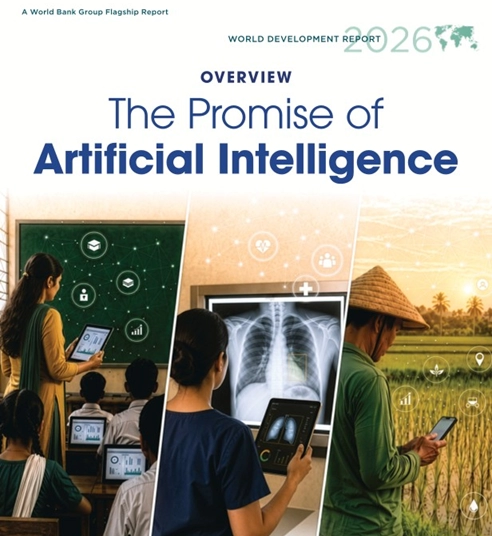
The World Bank Group’s World Development Report 2026, titled “The Promise of Artificial Intelligence,” highlighted Saudi Arabia’s growing position in the global AI landscape. “The Kingdom has become an attractive destination for AI talent and a model for government data integration,” the report pointed out.
This international recognition reflects the support and empowerment of the Kingdom’s leadership through an integrated national approach established by Saudi Vision 2030 to build an economy driven by data, compute, and innovation, and to reinforce the Kingdom’s position in shaping the future of artificial intelligence.
The recently released report is the World Bank’s first comprehensive assessment of the impact of artificial intelligence on developing economies, the opportunities it creates for individuals, firms, and governments, and the requirements needed to maximize its development impact while managing associated risks.
The report is structured around three key dimensions that shape the impact of artificial intelligence on development: Capabilities, through which AI can broaden access to expertise and support decision-making; concentration, resulting from the production of advanced models, chips, and data centers being concentrated in a limited number of countries and companies; and complements, including infrastructure, data, skills, and institutions.
Through these dimensions, the report outlines a progressive pathway that begins with adopting available tools, moves toward adapting them to local languages, data, institutions, and needs, and ultimately advances toward developing cutting-edge technologies and the infrastructure that enables them.
The report emphasizes that harnessing the benefits of artificial intelligence depends not only on having the largest models, but also on building an interconnected ecosystem encompassing connectivity, compute, data, skills, and institutions. It notes that solutions tailored to local contexts can broaden access to expertise, increase productivity, improve public services, and support economic growth.
Under the Concentration dimension, which examines the concentration of advanced AI infrastructure and related investment, the report noted that Saudi Arabia combines tax incentives with special economic zones to attract investment in data centers and build compute capacity. This national approach links capital attraction with the development of a broader ecosystem encompassing talent, startups, energy, and the infrastructure required to support the growth of AI applications.
This recognition aligns with the rapid growth of the Kingdom’s digital infrastructure. Data center capacity increased from 68 MW in 2021 to 440 MW in 2025, before rising further to 467 MW in the first quarter of 2026, representing an increase of more than 6 percent since the beginning of the year and nearly sevenfold compared with 2021. The 4G and 5G network coverage reached 99 percent by the end of 2025, while average internet speed reached 216 Mbps, providing key enablers for the expansion of cloud services and AI applications.
Under the Capabilities dimension, the report highlighted Saudi Arabia’s ability to attract specialized talent, noting that in 2025 the Kingdom was among the economies with the highest net inflows of AI professionals per 10,000 LinkedIn members, alongside Luxembourg, Australia, and Switzerland. Saudi Arabia also recorded a net inflow of 3.08 among leading AI authors and innovators in the same year, reflecting the growing attractiveness of the Saudi technology ecosystem to highly specialized talent.
This momentum is accompanied by continued growth in the Kingdom’s national talent base. Saudi Arabia’s technology workforce has grown to approximately 426,000, representing cumulative growth of 186.6 percent compared with 2018, when it stood at 150,000. Women’s participation in communications and information technology professions has also risen to 35 percent, broadening the Kingdom’s talent pool and strengthening the diversity of capabilities supporting an economy driven by technology and innovation.
Under the Complements dimension, the report presents Saudi experience as a model for building public data infrastructure. It highlights a platform operated by the Saudi Data and Artificial Intelligence Authority (SDAIA) that enables data integration across more than 60 government entities while allowing the data to remain within their respective systems. The report presents this experience as a model for structured data exchange, enabling government entities to develop more effective applications while strengthening governance, trust, and data protection.
This progress builds on broader achievements across the digital economy, whose contribution has risen to 16 percent of GDP, while the communications and information technology market reached SR199 billion in 2025.
Saudi Arabia also ranked second globally in the World Bank Group’s 2025 GovTech Maturity Index. The preparation of the report also reflects the Kingdom’s presence in the international dialogue on artificial intelligence policy. The report’s High-Level Advisory Panel included Minister of Communications and Information Technology Abdullah Alswaha. The report team also benefited from consultation sessions involving the Saudi Competitiveness and Business Center and the WBG–Saudi Arabia Knowledge Hub, alongside national government, private-sector, and research entities that contributed their expertise in data, telecommunications, compute, and innovation.
The report’s release carries particular significance following the Cabinet’s approval, during its session chaired by Crown Prince and Prime Minister Mohammed bin Salman, on March 10, 2026, to designate 2026 as the “Year of AI” in Saudi Arabia, underscoring the Kingdom’s national focus on future technologies and their role in advancing development, innovation, and competitiveness.
The findings highlighted in the World Bank report affirm that Saudi Arabia is advancing an integrated approach in the intelligent era, bringing together investment in infrastructure, compute and data, talent development, the regulatory environment, and the expanded application of technology across the economy and public services. This approach reinforces the Kingdom’s position as a global hub for data and artificial intelligence and supports the objectives of Saudi Vision 2030.
Source: Saudi Gazette