

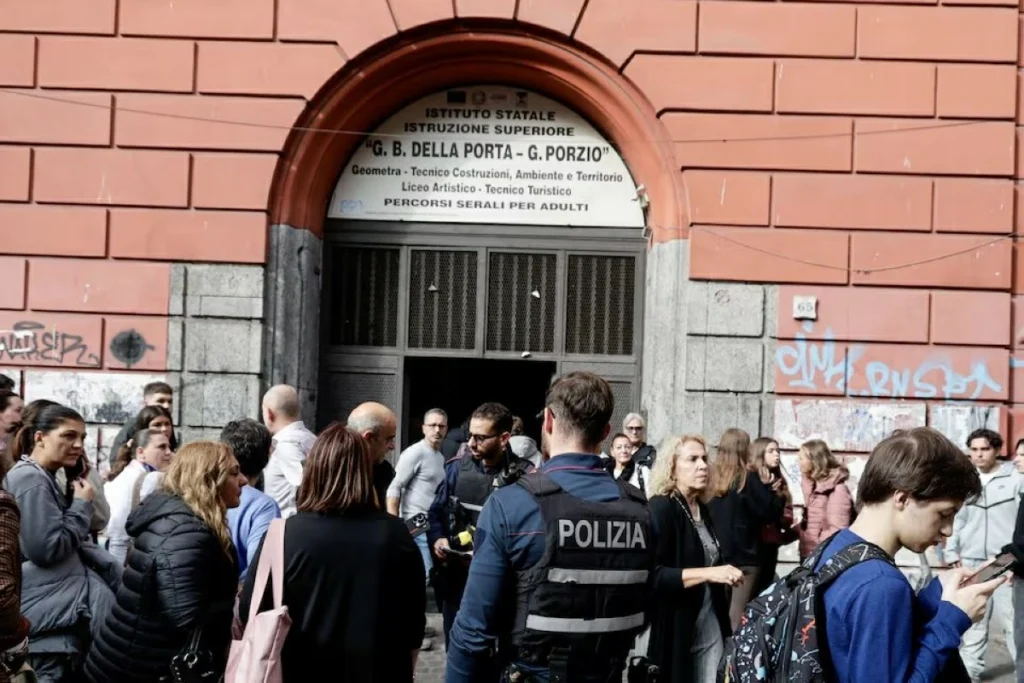
ROME — At least 100 Italian schools received emailed bomb and poison threats on Monday, triggering a new security protocol introduced by the government following similar threats last week.
The email arrived at around 10:50 am, signed with the initials MA, warning of two imminent dangers.
“I have just been tasked with placing and activating an explosive device in your building. The explosion will take place in 40 minutes,” it said, while also claiming that “an employee in your canteen has mixed a toxic substance including sodium azide and potassium cyanide into the food and supplies.”
“You have ignored our demands,” it added.
On this occasion, the threats prompted just a handful of evacuations. Checks on food served in school canteens did not reveal any anomalies.
Under new security guidelines, Italian schools are no longer automatically evacuated in response to such vague, mass-distributed threats, with the decision left to the discretion of law enforcement and security officials.
Prime Minister Giorgia Meloni’s government said public buildings should be cleared only if there is concrete evidence of danger after a wave of fake bomb alerts on Wednesday triggered school closures across Italy.
On Thursday, 3,778 schools received threats but only 77 were evacuated, some of them for only a short while, the prime minister’s office said. The alarm had been more widespread on Wednesday, when 6,300 schools were affected and panic spread among parents.
Monday’s messages came from the email account of a Vietnamese institution, which is believed to have been hacked. The address [email protected] is linked to a research centre in the city of Da Nang.
Italy’s postal police have since launched an investigation into the incident.
“We are facing an investigative challenge: the simpler the operation, the harder it is to identify an error by the person who carried out the attack,” Ivano Gabrielli, director of the cyber police service, told SkyTg24. “These days, retrieving an email from the dark web and using it anonymously is unfortunately very easy from a technical point of view.”
But he added that whoever set up the infrastructure to send such a large number of emails may still have made a mistake that investigators can find and pursue.
Speaking in Brussels, Italian Foreign Minister Antonio Tajani said there was a “shared vision and desire to be increasingly united in responding to attacks and preventing different types of threats by email, cyber or hacking.”
Some European officials suspect Russia may be behind a campaign of disruption to everyday life in European nations supporting Ukraine after Moscow’s invasion.
Italian officials have so far said there was no evidence of that. Russia denies involvement and accuses the West of a smear campaign.
Russia’s ambassador to Italy said on Thursday that the Russian authorities were ready to help their Italian counterparts to track down whoever was behind the threats.
Source: Saudi Gazette