

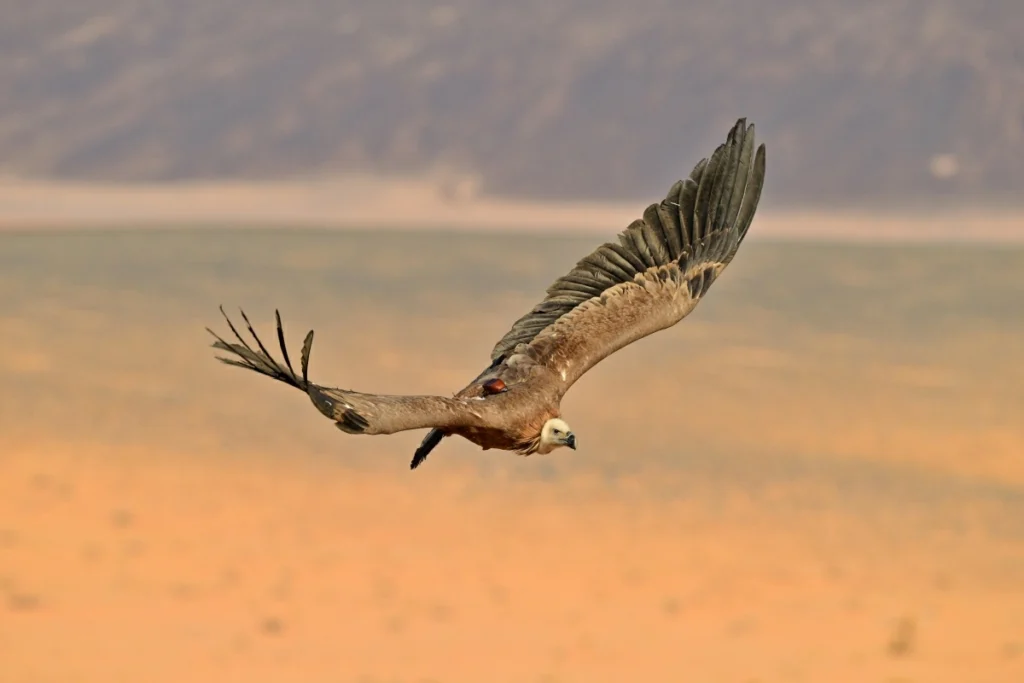
TABUK — Two Eurasian Griffon vultures rehabilitated and released from Prince Mohammed bin Salman Royal Reserve have established new home ranges in Armenia and Iraq after journeys spanning eight countries across the Middle East.
Tracking data released by the reserve to mark International Vulture Awareness Day shows that the two birds, known as Vultures 536 and 535, have remained within 100 kilometers of their respective home ranges after years of movement across the region.
Vulture 536 has settled in Armenia, while Vulture 535 has made its home in Iraq.
Tagged Eurasian Griffon vulture in flight in Prince Mohammed bin Salman Royal Reserve. (Supplied)
The birds were released from Prince Mohammed bin Salman Royal Reserve in northwestern Saudi Arabia in April 2023. They subsequently spent around 17 months ranging across the region before settling into their current territories.
Vulture 536 traveled through Jordan, Syria, Iraq, Türkiye, Armenia, Azerbaijan and Iran, while Vulture 535 crossed Saudi Arabia, Jordan, Iraq, Türkiye and Iran.
Their combined movements were equivalent to circumnavigating the Earth six times, according to the reserve. Yet during the past two years, neither bird has ventured more than 100 kilometers from its chosen home range.
Scientists at the reserve believe their flight patterns indicate that the vultures have become residents within wild Griffon vulture populations in Armenia and Iraq.
The transition marks an important stage in the birds’ lives. Eurasian Griffon vultures commonly shift from long-distance movement to localized, year-round residency as they mature and establish themselves within breeding colonies, with their movements influenced by food availability and environmental conditions.
Tagged Eurasian Griffon vulture in Prince Mohammed bin Salman Royal Reserve. (Supplied)
For the reserve, the journeys also demonstrate how satellite tracking can provide conservationists with a picture of wildlife movements that extend far beyond national borders.
“The use of technology at Prince Mohammed bin Salman Royal Reserve is allowing us to track migratory, long-range species such as Eurasian Griffon vultures, Hawksbill and Green turtles in real time and inform management and conservation plans in ways never before possible,” said Andrew Zaloumis, CEO of Prince Mohammed bin Salman Royal Reserve.
“This tracking data highlights the importance of cross-boundary conservation solutions,” he added.
While the Eurasian Griffon vulture is classified as Least Concern by the International Union for Conservation of Nature (IUCN), vultures globally face a much more precarious future. Around 70 percent of the world’s vulture species are threatened with extinction, according to the IUCN.
The journeys of Vultures 535 and 536 highlight the challenge of protecting species whose ranges can stretch across numerous countries and ecosystems, making international conservation cooperation essential.
Both birds were fitted with satellite tracking tags using biodegradable straps designed to detach naturally over time. The reserve will continue monitoring them for as long as their tags remain active.
Prince Mohammed bin Salman Royal Reserve covers 24,500 square kilometers, stretching from the Harrat lava plains to the Red Sea and connecting NEOM, Red Sea Global and AlUla.
Despite accounting for around 1 percent of Saudi Arabia’s terrestrial area and 1.8 percent of its marine area, its 15 ecosystems support more than half of the Kingdom’s mammal and bird species.
The reserve is undertaking a wider rewilding program that aims to reintroduce 23 historically occurring native species. Eleven have already been reintroduced, including the Arabian oryx, Persian onager, sand gazelle and mountain gazelle.
Source: Saudi Gazette