

Christopher Nolan’s The Odyssey arrives in theaters this Thursday, July 16, in preview screenings, bringing with it the kind of anticipation usually reserved for once-in-a-generation cinematic events.
But for millions of moviegoers, there’s one unavoidable problem before they even buy a ticket:
They simply can’t watch the film the way Christopher Nolan intended it to be seen.
The Odyssey isn’t just another blockbuster released in IMAX.
Stay up to date with the latest news. Follow KT on WhatsApp Channels.
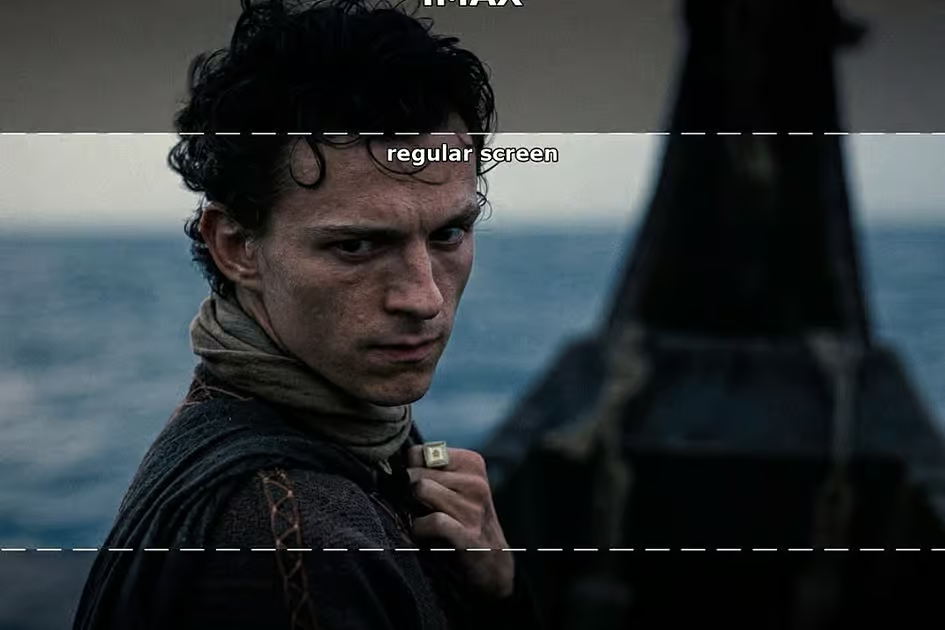
It is the first feature film in history shot entirely using IMAX 70mm film cameras, making every shot, composition, and visual effect designed around the massive 1.43:1 IMAX frame.
That creates a major difference between IMAX and standard theaters.
On a genuine IMAX 70mm screen, audiences see the full image Nolan photographed.
In conventional theaters, even premium multiplex screens, the movie is presented in a much wider format, meaning significant portions of the top and bottom of every frame are cropped away.
The difference has become one of the biggest talking points online after comparison images circulated showing Tom Holland’s Telemachus framed dramatically differently depending on the format.
Rather than simply getting a larger picture, IMAX viewers are literally seeing more of the movie.
Christopher Nolan has repeatedly argued that IMAX 70mm is the definitive way to experience the film, explaining that every single frame was composed specifically for that format.
That shortage has become one of the biggest frustrations surrounding the film’s release.
IMAX 70mm tickets disappeared almost immediately after going on sale nearly a year ago, with many locations selling out opening weekend within hours.
Since then, resale prices in major cities have climbed to several times face value, while some theaters are already fully booked weeks into the release.
The unprecedented demand has already rewritten the record books.
According to the BFI IMAX, London’s iconic venue and the UK’s largest cinema screen, The Odyssey sold 28,000 tickets within its first 24 hours on sale, generating £750,000 in revenue and setting a new first-day sales record for the venue.
The film also surpassed the previous records set by Dune: Part Two (£366,000) and Christopher Nolan’s Oppenheimer(£254,000) during the same period.
The demand has become so intense that audiences are buying tickets for 2 a.m. and even 7 a.m. screenings, while others are travelling across states and, in some cases, across countries just to find one of the few theaters capable of showing the film in its intended format.
The obvious question then becomes: if demand is this high, why doesn’t IMAX simply build more IMAX 70mm theaters?
According to IMAX CEO Richard Gelfond, the answer has little to do with demand and everything to do with the technology.
Today, only 41 cinemas worldwide are capable of projecting The Odyssey in IMAX 70mm.
Speaking with Variety at the film’s New York premiere, Gelfond said demand has exceeded anything the company expected.
“We’re sold out in some theaters into the fifth week already, and the 2am shows, the 7am shows, so there’s certainly more demand.”
But expanding the format isn’t as simple as installing new projectors.
“The problem is they haven’t made new IMAX film projectors in about 50 years. So we retrofit them, we rebuild them, and part of our strategy is to see how far we could take it. But certainly, demand-driven, I’d like to see more.”
When asked why IMAX couldn’t simply manufacture brand-new IMAX 70mm projectors, Gelfond explained why the idea isn’t practical.
“We build new projectors every day, but film projectors using this film, it’s not practical. So we’ve got to find them, and we’ve got to rebuild them, which is what we did for The Odyssey. But can all 2,000 of our theaters have the film projectors? No, there’s just not that many around. But I think we could continue to grow it.”
Unlike digital IMAX systems, IMAX 70mm projection relies on equipment that has largely disappeared from modern cinemas.
Rather than manufacturing new projectors, the company spends years locating surviving machines, restoring them piece by piece, sourcing replacement components, and training projectionists capable of operating equipment that many theaters retired decades ago.
Ahead of both Oppenheimer and now The Odyssey, IMAX refurbished dormant projection systems around the world, expanding the number of venues capable of screening Nolan’s films. But with only a limited number of projectors still in existence, there is only so much the company can do.
For IMAX, preserving the format has become less about building new technology and more about keeping a piece of cinema history alive.
Christopher Nolan has spent nearly two decades pushing IMAX film further than anyone else in Hollywood, and The Odyssey may be his biggest contribution to the format yet.
Traditional IMAX film cameras were never designed to shoot an entire dialogue-driven feature. They are enormous, notoriously loud, and consume massive rolls of film that typically need replacing every three minutes.
Working alongside IMAX engineers over several years, Nolan helped develop quieter versions of the cameras, making it possible to record dialogue directly on IMAX 70mm film.
Those improvements ultimately allowed The Odyssey to become the first feature ever photographed entirely using IMAX 1570 film cameras.
In many ways, Nolan hasn’t simply continued using IMAX film. He has played a major role in keeping the format alive, pushing its technology forward and proving it can still be used at the highest level of modern filmmaking.
For theater owners, investing in IMAX 70mm projection simply isn’t practical when only a handful of films are made specifically for the format.
Christopher Nolan has become the biggest advocate for IMAX 70mm filmmaking, and The Odyssey is the culmination of that effort. Every scene, every shot, and every frame was photographed specifically for the full IMAX frame, making it unlike any feature film released before.
Ironically, that’s exactly what has frustrated many fans.
Across social media, countless moviegoers have expressed disappointment that despite paying for a theatrical ticket, they still won’t be watching the film exactly as Nolan photographed it.
For many, it’s less about seeing a “bigger screen” and more about missing a significant portion of the image the director intended audiences to experience.
One fan wrote: “The only theatre that is pretty full in my city is the IMAX one. The rest are mostly empty as of today.”
Another fan argued that the experience goes far beyond image quality:
“IMAX is made to be seen on a massive screen that surrounds you with the image, which is very different than if you watch a 4:3 film on a TV in your living room. You can’t really compare IMAX to widescreen on a TV at home when the entire point of IMAX is the theatrical experience, and the framing feels very different on that huge screen than it would in your living room.”
Although IMAX 70mm remains the definitive presentation, The Odyssey has also been mastered for IMAX Laser, digital IMAX, Dolby Cinema, and standard theatrical release, allowing audiences everywhere to experience Nolan’s latest film with outstanding image quality.
Still, for many fans, that hasn’t eased the disappointment.
Across social media, one sentiment appears again and again. They aren’t upset because they aren’t getting “the best” version. They’re upset because they feel they aren’t getting the same movie Christopher Nolan shot.
Many pointed out that, unlike differences in brightness, sound, or resolution, the standard theatrical version actually removes a substantial portion of the image from every frame because of the aspect ratio.
For many fans, The Odyssey has highlighted just how rare the true IMAX 70mm experience has become.
It’s become a reminder that some cinematic experiences remain genuinely exclusive, not because audiences don’t want to see them, but because the technology required to show them exists in only 41 theaters around the world.
Source: Khaleej Times